
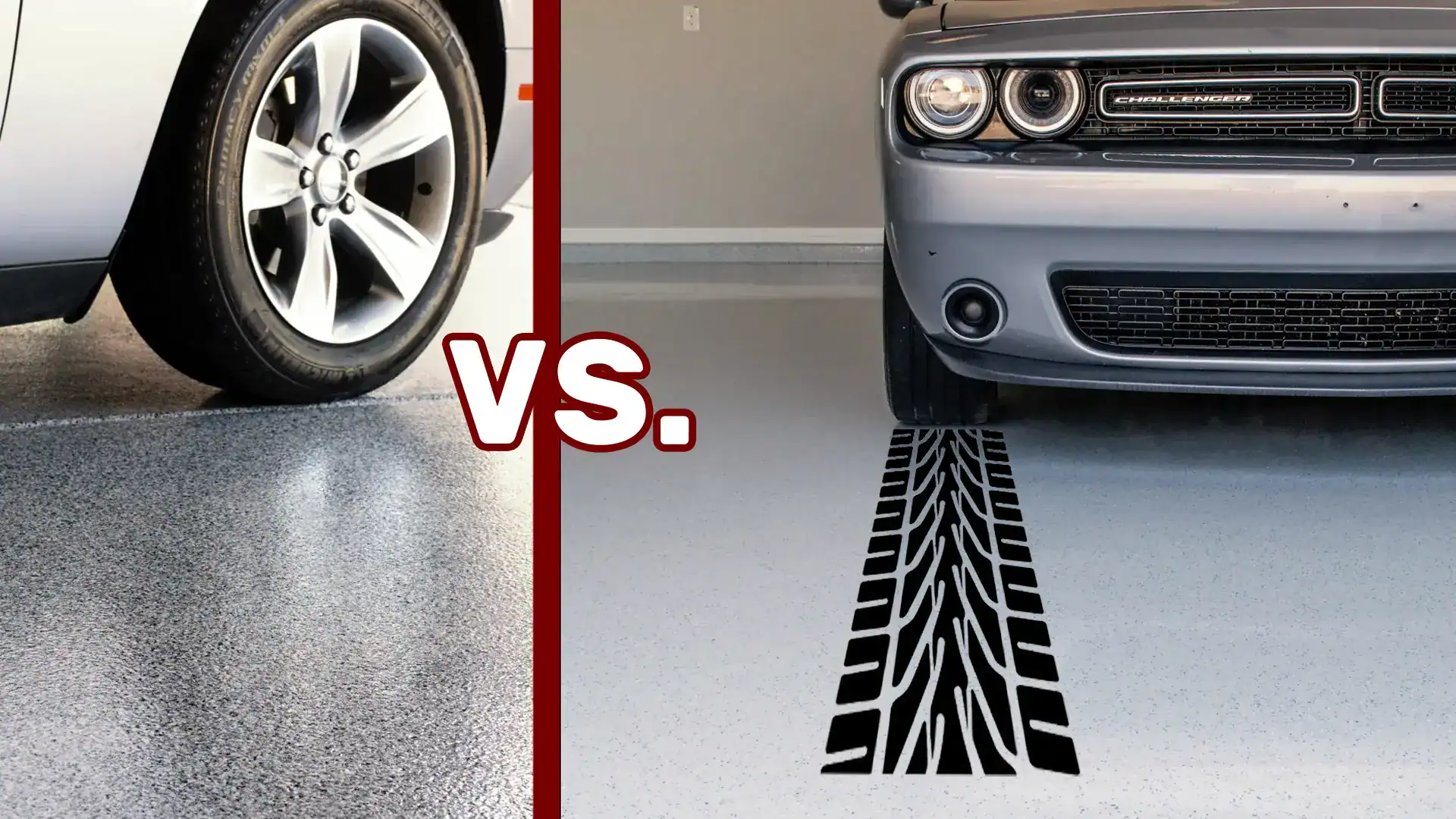
You just hired a company to install a “1-day” garage floor coating. Your garage floor looks brand new. Smooth, clean, and ready to use. But the moment you park your car, hidden damage can begin if the system is not built correctly. Hot tire transfer is one of the leading causes of early coating failure. A professionally installed polyaspartic floor coating is designed to stop it before it starts.
What Happens When Heat and Pressure Take Over
Many 1-day garage floor coatings rely on thin, less-than-100%-solids polyurea-polyaspartic layers applied as: (a) the direct-to-concrete primer coat (really bad idea), and (b) as the single, clear protective top coat. While these quick-cure systems can be installed in the promised “1 day”, they lack durability, especially with regard to moisture mitigation and hot-tire transfer. Speed over quality.
We have discussed in depth in prior blogs why polyurea-polyaspartic coatings should not be used as direct-to-concrete primers (Hint: they go down thinly and cure so quickly, especially in the presence of moisture, that they fail to deeply penetrate the concrete slab. They are poor moisture vapor barriers). Polyurea-polyaspartics are designed to be used as color coats or clear top coats….not primer coats! But if the quality of the polyurea-polyaspartic is low (e.g., 1:1 ratio, low density cross-linking, and less-than-100%-solids), they can be problematic as clear top coats too. Here’s why.
Car tires contain plasticizers that keep rubber flexible. As tires heat up during driving, these softening agents migrate to the tire’s surface. When parked, the plasticizers transfer into the coating below. Over time, this leads to staining, surface tackiness, and even adhesion breakdown.
Hot tire transfer is not just cosmetic. It is a warning sign that the garage floor coating is failing.
Why a 2-Day Polyaspartic Floor Coating Makes the Difference
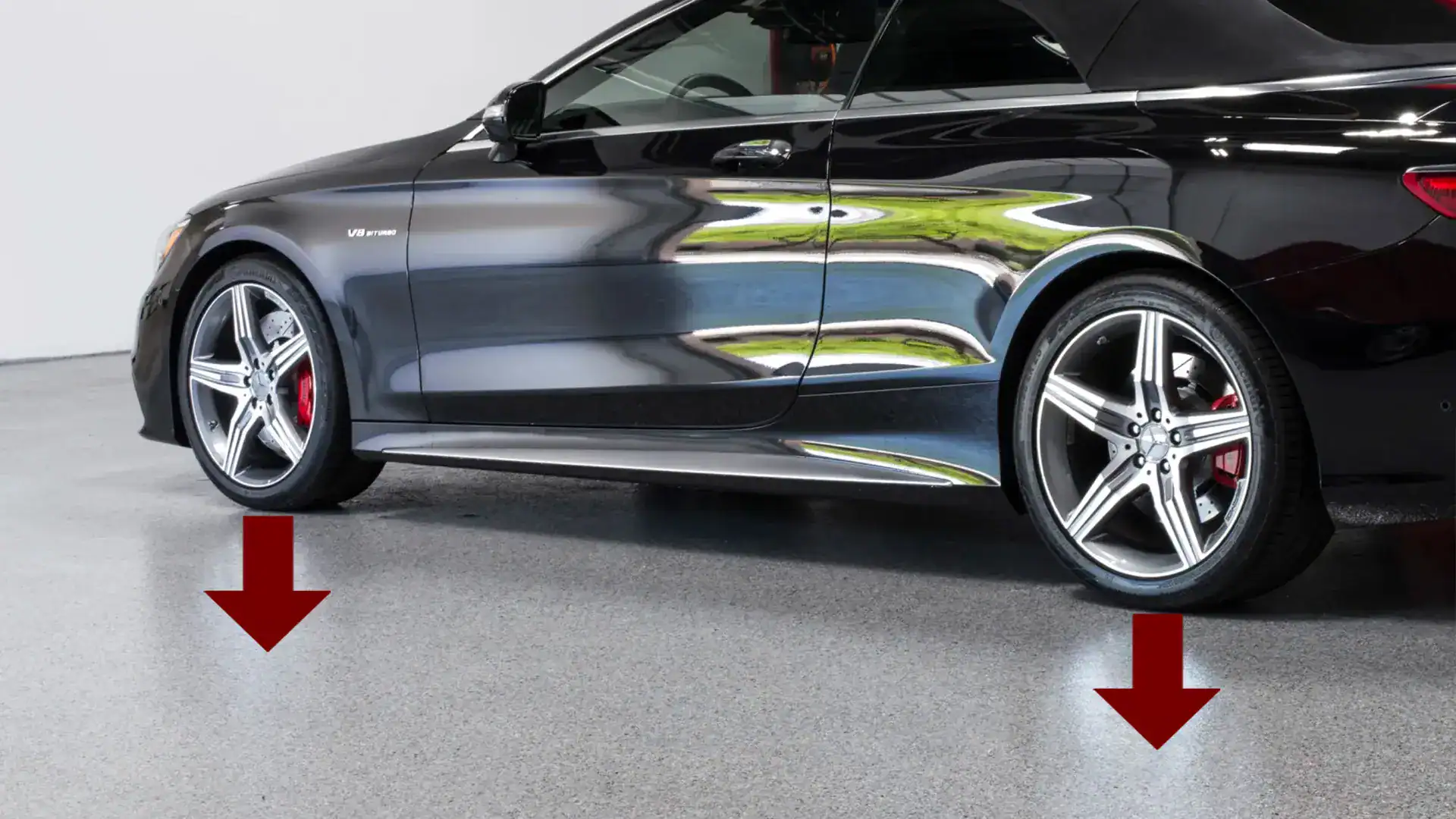
Conversely, at Garage Floor Coating of Houston, we install hybrid epoxy and polyaspartic coating systems that take 2 days to properly apply. These systems take a little longer to install but they provide long-term performance. Quality over speed.
For example, day one starts with mechanical grinding to prepare the concrete slab. Then, a high-build, moisture-mitigating, 100%-solids epoxy base coat is applied to act as the moisture vapor barrier. Into to this layer, the customer’s selected flake blend is broadcast in a full spread, adding visual appeal and strength. This base (primer) coat is allowed to cure overnight for deep concrete penetration.
Finally, on day two, two separate layers (not just one!) of our high cross-linking, 3:2 ratio, 100%-solids polyaspartic are applied. These dual clear topcoats create a tough, protective surface that resists heat, pressure, chemical exposure…and hot-tire transfer.
Designed for Heat and Humidity
A properly installed polyaspartic floor coating provides more than visual appeal. It creates a UV-stable, durable barrier that prevents hot tire pickup and holds up under Houston’s heat and humidity.
Without a system designed for these conditions, even new coatings can begin to show wear quickly.
Before you park your car, make sure your floor is built to last.
Contact Garage Floor Coatings of Houston today to learn more about a polyaspartic floor coating system that prevents hot tire transfer from day one.